

Popular keywords: Lithium battery | Down tube battery box | Folding bicycle battery box | Built-in battery box
Power lithium batteries have steadily occupied the position of the leader in the power supply of electric vehicles. Long service life, high energy density, and great potential for improvement. Safety can be changed, and energy density can continue to rise. It can catch up with the endurance and cost-effectiveness of fuel vehicles. However, lithium batteries also have the troubles.
We will analyze from the following 5 aspects:
1. Why are lithium batteries small
2. How do li-ion batteries protect their own safety
3. Why lithium battery pack
4. The harm of inconsistent cells to the lithium battery pack
5. How to deal with the inconsistency of batteries
Why are lithium battery small?
The lithium batteries: cylindrical batteries, soft-pack batteries, and square batteries that we see are generally small in appearance. You can't find the big guys like traditional lead-acid batteries at all. Why?
With high energy density, lithium batteries are often afraid to design large capacity. The energy density of lead-acid batteries is around 40Wh/kg, while lithium batteries have exceeded 150Wh/kg. With the increase in energy concentration, the requirements for safety are rising.
First of all, it is very dangerous for lithium batteries to have an excessive amount of energy, when encountering an accident, it will cause thermal runaway and a sharp reaction inside the battery. In a short time, too much energy is nowhere to be released, which is very dangerous. Especially when the development of safety technology and management and control capabilities is not sufficient, the capacity of each battery should be restrained.
Secondly, once an accident occurs, the energy wrapped in the lithium battery shell will be inaccessible and powerless by firefighters and extinguishing agents. They can only isolate the scene in the event of an accident and allow the accident battery to react by itself until the energy burns out.
How do li-ion batteries protect their own safety?
Take a cylindrical battery as an example.
1) The safety valve, when the internal reaction of the battery exceeds the normal range, the temperature rises, and with the generation of side reaction gas, the pressure reaches the design value, the safety valve automatically opens to release the pressure. The moment the safety valve opens, the battery fails completely.
2) Thermistor, some cells are equipped with thermistor. Once overcurrent occurs, after the resistance reaches a certain temperature, the resistance value increases sharply, and the current in the loop decreases, preventing the temperature from rising further.
3) The fuse, the cell is equipped with a fuse with over-current fusing function. Once the over-current risk occurs, the circuit will be disconnected to avoid the occurrence of vicious accidents.
Why lithium battery pack ?
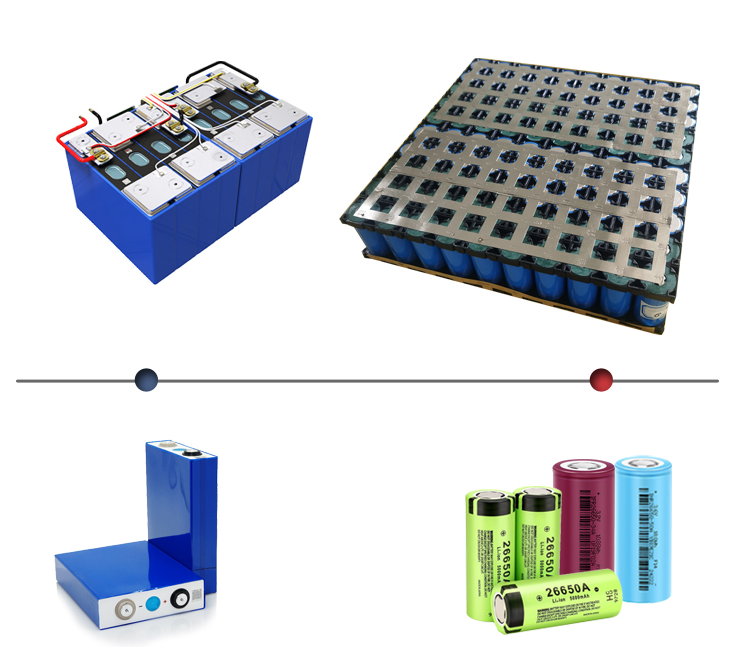
Lithium batteries can't be made into one large one, so many small batteries have to be organized. Everyone can work together and cooperate with each other to fly with electric cars. At this time, there is a problem that needs to be faced: consistency.
The harm of inconsistent cells to the lithium battery pack
The inconsistency of lithium battery parameters mainly refers to the inconsistency of capacity, internal resistance, and voltage. If inconsistent batteries are used in series and parallel,the following problems will occur.
1) Capacity loss. Single cells form a battery pack. The capacity conforms to the "barrel principle". The capacity of the worst cell determines the capacity of the entire battery pack.
In order to prevent the battery from overcharging and overdischarging, the logic of the battery management system is set as follows: when discharging, when the lowest cell voltage reaches the discharge cut-off voltage, the entire battery pack stops discharging; when charging, when the highest cell voltage touches the charge cut-off voltage To stop charging.
Take two batteries in series as an example. One battery has a capacity of 1C, and the other has a capacity of only 0.9C. In a series connection, two batteries pass the same amount of current. When charging, the battery with a small capacity must be fully charged first, and the charging cut-off condition is reached, and the system will not continue to charge. When discharging, a battery with a small capacity will inevitably emit all available energy first, and the system will stop discharging immediately. In this way, batteries with small capacity are always fully discharged, while batteries with large capacity always use part of the capacity. Part of the capacity of the entire battery pack is always idle.2) Life loss, similarly, the life of the battery pack is determined by the cell with the shortest life. It is very likely that the cell with the shortest life span is the cell with a small capacity. Small-capacity batteries are fully charged and discharged every time, and they are likely to reach the hour of life first. The life of one battery cell ends, the group of battery cells welded together will die.
3) The internal resistance increases, the same current flows through different internal resistances, and the cells with large internal resistance generate more heat. The battery temperature is too high, causing the deterioration rate to accelerate, and the internal resistance will further increase. Internal resistance and temperature rise form a pair of negative feedback, which accelerates the deterioration of high internal resistance cells.
The above three parameters are not completely independent. The internal resistance of the battery with a deep aging degree is relatively large, and the capacity attenuation is also more.Explained separately, just to express clearly their respective directions of influence.
How to deal with the inconsistency of batteries?
The inconsistency of battery cell performance is formed during the production process and deepened during use. The batteries in the same battery pack are weak will become weaker. The degree of dispersion of the parameters between the single cells increases as the degree of aging deepens.
At present, engineers mainly consider three aspects to deal with the inconsistency of single cells: Single battery sorting, thermal management after grouping, the battery management system provides equalization function when there is a small amount of inconsistency.
1) Sorting
Different batches of batteries should not be used together in theory. Even batteries of the same batch need to be screened, and batteries with relatively concentrated parameters are placed in a battery group and in the same battery pack.
The purpose of sorting is to select cells with similar parameters. The sorting method has been studied for many years, mainly divided into two categories: static sorting and dynamic sorting.
Static sorting is to screen the voltage, internal resistance, capacity and other characteristic parameters of the cells, select the target parameters, introduce statistical algorithms, set the screening criteria, and finally divide the cells of the same batch into several groups.
Dynamic screening is based on the characteristics of the battery cell during the charging and discharging process. Some choose the constant current and constant voltage charging process, some choose the pulse shock charging and discharging process, and some compare their own charging and discharging curves. relation.
Combining dynamic and static sorting, static screening is used for preliminary grouping, and dynamic screening is carried out on this basis, so that more groups can be divided and screening accuracy is higher, but the cost will rise accordingly.
This reflects the importance of the scale of power lithium battery production. Large-scale shipments allow manufacturers to perform finer sorting and obtain battery packs with closer performance. If the output is too small and there are too many groups, one batch cannot be equipped with a battery pack, and no matter how good the method is.
2) Thermal management
Aiming at the problem of inconsistent internal resistance of the cells, the heat generation is not the same. The addition of the thermal management system can adjust the temperature difference of the entire battery pack to keep it in a small range. Cells that generate more heat will still have a high temperature rise, but will not be separated from other cells, and there will be no obvious difference in degradation level.
3) Balance
The inconsistency of the battery cells, the terminal voltage of some battery cells is always ahead of other batteries, and reaches the control threshold first, resulting in the reduction of the capacity of the entire system. In order to solve this problem, the battery management system BMS has designed a balancing function.
A certain battery cell is the first to reach the charging cut-off voltage, while the voltage of the other cells is obviously lagging behind. BMS activates the charge equalization function, or connects a resistor to release part of the high-voltage battery's power, or transfers the energy away and puts it to a low level. The voltage cell goes up. In this way, the charging cut-off condition is lifted, the charging process is restarted, and the battery pack is charged with more power.
Until now, the inconsistency of batteries is still an important area of research in the industry. No matter how high the energy density of the battery cell is, the battery pack capacity will be greatly reduced if it encounters inconsistency to disrupt the situation.
The latest insights on lithium battery technology sent straight to you.


ZHONGKE Copyright 2021